


Reading
#ClassicandContemporary book challenge: October
#ClassicandContemporary book challenge:
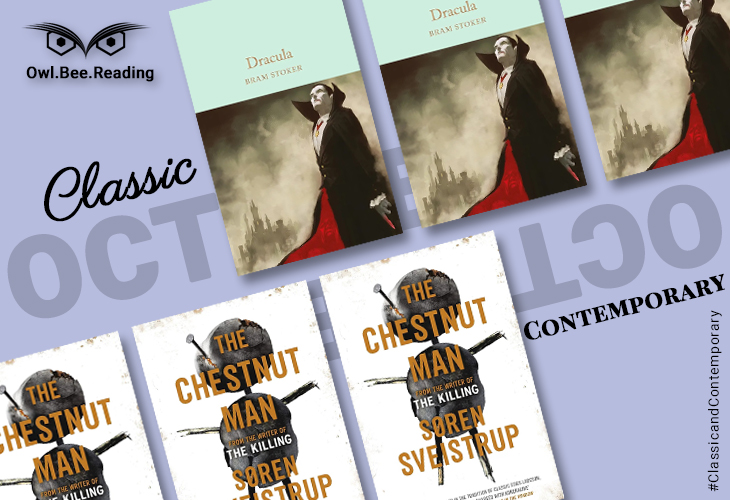
Dracula and The Chestnut Man
The Chestnut Man
Author: Søren Sveistrup
Genre: Thriller, Mystery, Crime
Publisher: Penguin Books
Year: January 2019
Rating: 
The Chestnut Man is one of those books that you know will stay with you for a long time. And you will most probably not look at chestnuts the same way ever again. A cosy and delicious snack, one that reminds you of cold autumn days in front of the fireplace? Not anymore.
The Chestnut Man is a psychological whodunnit full of action, complex characters and a lot of suspense. A Scandinavian noir set in Copenhagen, the perfect dark, wet and gloomy setting for the brutal murders. In your head you start forming your own police investigation board with suspects and clues, and they periodically change throughout the story. Sometimes you get surprised by the addition of a character, as you get hints about someone here and there, but in the end they all fail the test, and your mental puzzle is ruined, so you have to start all over again. It is exciting to be part of the police procedurals and also equally disturbing and terrifying. Let me give you the blurb:
If you find one, he’s already found you.
A psychopath is terrorizing Copenhagen.
His calling card is a “chestnut man”—a handmade doll made of matchsticks and two chestnuts—which he leaves at each bloody crime scene. Examining the dolls, forensics makes a shocking discovery—a fingerprint belonging to a young girl, a government minister’s daughter who had been kidnapped and murdered a year ago.
A tragic coincidence—or something more twisted?
To save innocent lives, a pair of detectives must put aside their differences to piece together the Chestnut Man’s gruesome clues.
Because it’s clear that the madman is on a mission that is far from over.
And no one is safe.
The book is quite creepy, especially when these sinister chestnut figurines start to appear randomly, they are like an omen that something terrible is about to happen… or has already happened. Either way, police officer Naia Thulin and her new and slightly eccentric colleague Mark Hess are trying to reveal the identity of the person who is responsible for all the macabre assassinations. As a reader, you want answers and you want them right away. However, you have to wait until every single suspect has played their role and you’ve learned everything about then. And even then, the ending will probably still shock you. The entire book feels like a game of hide and seek, “you run and I’ll chase you” kind of game. It’s the they-nearly-caught-him feeling that keeps you so curious about what is to happen next. The Chestnut Man is clever, there’s no doubt about that, but can the police officers be one step ahead? It seems to be always the opposite, no matter how close they seem to get, the Chestnut Man becomes more and more inventive with each murder. Bear in mind that the crime scenes are quite graphic and gory and that is something that adds a lot of dark atmosphere, fear and tension to the story. It is what is expected from a crime book after all, but still… you have been warned!
As a downside, I would probably point out the time spent on the each character’s background story. I just wasn’t interested in learning about their personal circumstances as much as I wanted to know about their professional lives. I preferred the parts where the Chestnut Man came into play, all the deciphering of how he acted and what they were doing to try and catch him. This is always tricky with crime books, the balance between following the progress of the investigation, revealing the actual crime and adding some elements of “normalcy”, some real life situations, to distract the reader from time to time and diffuse the tension. Alternating these two parts worked really well in this book despite all the background information, as it gave me the right amount of curiosity needed to keep me invested in the story and to keep coming back for more.
I am definitely keen on reading other Søren Sveistrup books and I am sure that the level of suspense will be as high, if not even higher, than in The Chestnut Man.
Dracula
(mini review)
Author: Bram Stoker
Genre: Gothic, Horror
Publisher: Archibald Constable and Company (now Constable & Robinson)
Year: May 1897
Rating: 
I knew a little bit about the story, of course, before starting the book, but I didn’t expect the part with Dracula to be that short! It was not particularly creepy, at least not compared to more contemporary Gothic novels. Though I am certain that at the time it was published it was a big deal in the horror genre – a revolutionary tale that laid the groundwork for modern vampires, Dracula is not the most terrifying novel anymore. Nevertheless, it’s still a classic with a huge influence on literature and popular culture. I enjoyed the description that Jonathan Harker, an English solicitor travelling from England to Eastern Europe, gave of Dracula and the terror he felt towards the creature felt quite genuine. I can’t say I was particularly drawn to the first part of the book but it was still far more enjoyable than the second that tells the story of Mina Murray, Harker’s fiancé. In it, Dracula becomes more of an absence than a presence, a shadow whose influence is felt but rarely seen, we only learn about his existence from Mina’s wounds and words.
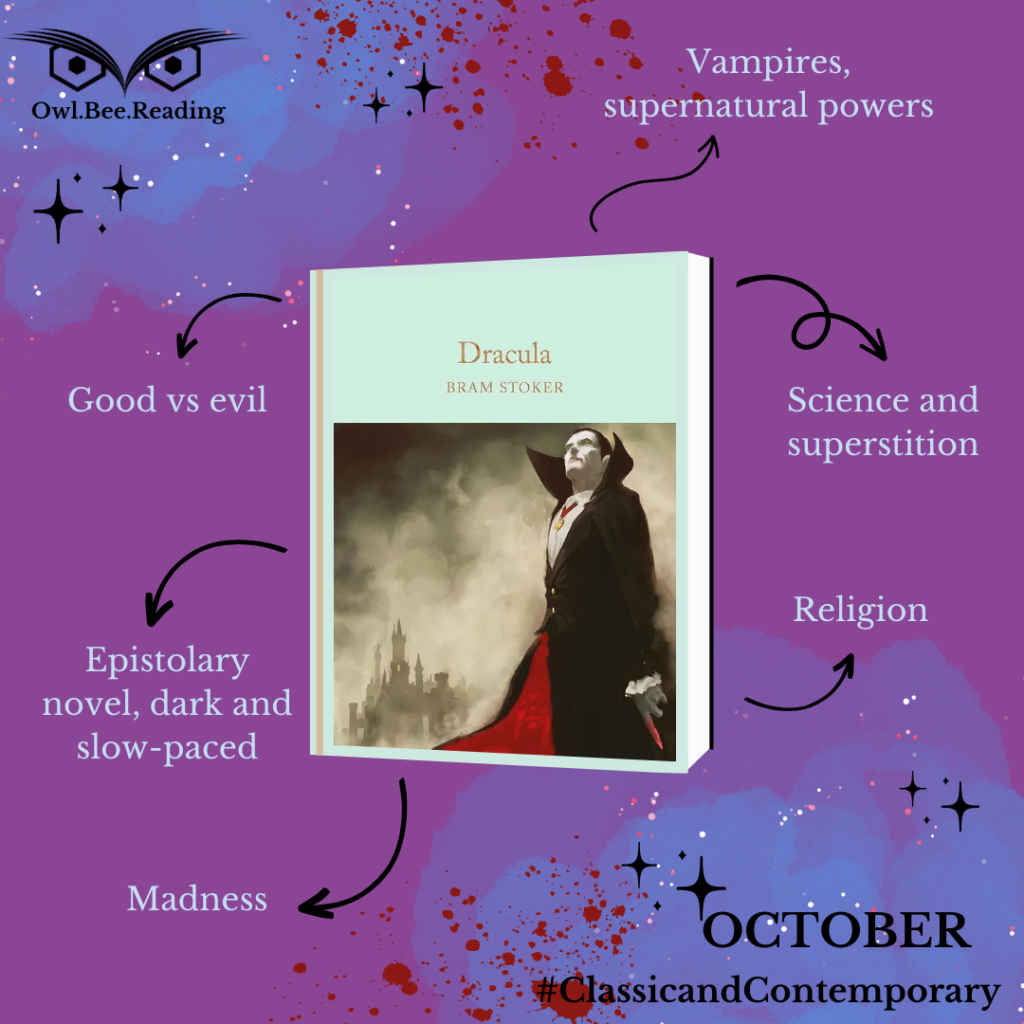
Starting from the beginning, we get an impression of what Count Dracula looks like from Jonathan Harker’s diary. In it, he relates his travels through the countryside to Mina. He gets invited to Dracula’s castle as he tries to sell the Transylvanian nobleman a property in London. As he sets off on his journey to the castle, his uneasiness grows because of the locals’ warnings of a werewolf, a vampire, something evil living nearby. Weird things start to happen as soon as he boards a horse-drawn carriage to take him to the castle: he’s under the impression of covering the same paths over again without advancing forward, hears wolves howling around and spots mysterious blue flames burning in the forest. The uneasy feeling and increasing creepiness don’t leave him, especially after meeting the Count himself. He meets three more female vampires who try to seduce him and realises in horror that he is Dracula’s next victim.
The next part of the book shifts its focus to Mina Murray and the group of men in her life. She is clever and organised, but the story also treats her as someone fragile who must be protected, which reflects Victorian ideas about women. The use of new technology, like typewriters, telegrams, blood transfusions, also shows the characters’ reliance on modern tools to fight something ancient and supernatural. This section of the book feels quite different to the previous chapters in terms of tone and pacing. The narrative is divided between multiple characters and locations, so the suspense never reaches the same intensity as the opening chapters. By the end, every diary entry and letter becomes a desperate attempt to impose order on something fundamentally unknowable and illusive. While this more chaotic structure is interesting, it makes the story feel less focused. The final fight with Dracula is surprisingly quick. After all the build‑up, the ending felt a bit rushed.
Still, Dracula is an important book. The first part, especially Harker’s stay in the castle, is full of atmosphere and tension. Stoker’s descriptions of the landscape, the castle and Dracula himself are vivid and memorable. And even if the story isn’t scary by today’s standards, it shaped almost everything we think of when we imagine vampires. In the end, I’m glad I read it. The book isn’t perfect, and I preferred the beginning to the rest of it, but it’s fascinating to see where so many modern vampire stories come from. 🧛♂️
In case you need me… #owlbeereading!


